In other parts of the world, biosolids for sewage treatment plants are treated and used as sustainable agriculture fertilizer. Research the pros and cons of this method and take a stand as to whether this can be a realistic alternative to our current agriculture practices. Who are the potential stakeholders in this issue? Are we influenced by the western view of human waste as an unsanitary and disgusting nuisance?

Biosolids also know as treated sludge, is a tern used by the wastewater industry to denote the by-product of domestic and commercial sewage and waste water treatment. Toxic chemicals such as PCBs, dioxin and brominated flame-retardants, may remain in treated sludge. Depending on their level of treatment and resultant pollutant content, biosolids can be used in regulated applications for non-food agriculture, food agriculture, or distribution for unlimited use.

PROS
· Creates jobs
· It is a cost effective method of disposal
· Recycles versus filling landfills
· Promotes farming
· Reduces emission form transportation to landfills
· Good free fertiliser
· Land Reclamation
· It’s regulated according to EPA law 503

CONS
· Potential health hazard
· Effects irreversible
· Contamination resulting from accumulation of industrial waste
· Its true composition is unknown
· May contain hazardous chemicals
· Possibly transferable crops
· Decreases property value
· Not sufficiently regulated
· Odour

Biosolids are regulated at both the federal and state level. Biosolids must first meet several quality standards and policies in order for them to be applied to land. These standards contain limits for metals that may exist in biosolids, site rule and regulations, pathogen standards, record keeping rules and soil monitoring requirements.
National Academy of Science has said that the use of these materials in the production of crops for human utilization when practiced in agreement with existing federal guidelines and regulations, presents negligible risk to the consumer, to crop production and to the environment.

About 95% of the nitrogen in biosolids exists in an organic form that has a slow release rate, which makes it much less likely to run off into streams.

The pro of biosolids in Canada is that Halifax Regional Municipality can get rid of its solid waste problem by giving it away. However the cost to treat waste and make it into biosolids is $175/ton. This means that we are subsidizing this process with out taxes. Farmers are being asked by major retailer if they are growing their food with biosolids, the intent being that the retailer are not happy with a yes. Insurance companies are informing farmers that they consider biosolids to be in breach of existing policies. Human waste isn’t really a good fertilizer substitute because of our diets.
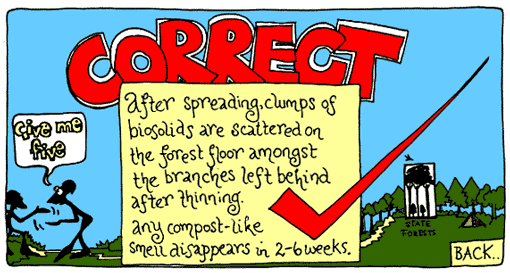
I think that Biosolids have both positive and negative effects on the earth and people. I also don’t believe that biosolids as know as human waste is a good fertilizer because of all of the artificially selected foods we eat. Biosolids is a sort of pollution, which will affect the air around us and the oxygen we take in. They should conduct more experiments and research more before they go ahead and use human waste as fertilizers in farms and other lands. While biosolids certainly provide valuable nutrients to agricultures, advocates of biosolids have not adequately addressed concerns raised but those oppose to the practise. Biosolids are believed to be linked with declining sperm counts and reproductive failure. Therefore we need more research on this topic before biosolids can be used as fertilizers.

http://youtube.ca/watch?v=QpiZReZG4_A
WORKCITED
http://www.ncbi.nlm.nih.gov/pubmed/18023841
http://www.antijen.org/transadvocate/id22.html
http://southeastfarmpress.com/grains/fertilizer-alternatives-0604/
http://thechronicleherald.ca/NovaScotia/1176241.html
http://www.schwingbioset.com/news/bid/34089/Natural-Fertilizer-from-Biosolids-reuse-to-the-Nth-degree-Part-I
http://www.cwwa.ca/faqbiosolids_e.asp
http://ehpnet1.niehs.nih.gov/qa/105-1focus/focusbeauty.html


 Imagine your self-enjoying a nice salad at a restaurant and later discovering that all the “healthy” vegetable that you have just consumed were artificially selected. Everyone tells you that a salad is a good choice and that it’s good for you, but in this case is it really? On daily basics we consume many artificially selected products with out us realizing and we never take a second to think about it and we can simply blame units. This topic is related directly to the pervious topic of designer babies. I had agreed that designing a baby was wrong but some how when I thinking of artificially selected plants or animals it seems different. Even though I know its wrong something in the back of my mind tells me that this is a different situation. But when thinking a baby is a living thing and so are plants and animals. And we should be cloning them or artificially selecting them.
  There are many advantages to artificial selection like disease. Which could be prevented by perceiving people/ animals/ plants that are genetically prone to certain hereditart diseases, and preparing for the inevitable. Implanting genes that code for antiviral as well can treat infection diseases. Animals and plants can be altered to show desirable characteristics. Genes could also be manipulated in trees for example, to absorb more CO2 and reduce the threat of global warming. Genetic engineering could also increase diversity and produce more variant alleles, which could also be crossed over and implanted into other species. It is possible to modify the genetics of wheat plants to grow insulin for example.
  There are also disadvantages to artificial selection. Nature is a tremendously complex inter- related chain consisting of many species linked in the food chain. Some scientist’s believe that introducing genetically customized genes may have an irreversible effect with consequences yet unknown. Genetic engineering borderline on many moral issues, particularly involving religion, which question whether man has the right to influence the laws and path of nature.
  The plants with desirable characteristics are grown by man and their numbers increase. But, plants without theses characteristics are less likely to survive, as they are not provided with the fertilisers and pesticides by man. Eventually, the species of the plant will vanish.
  Many will say that artificially selecting or modifying the genes of animals and plants similar would save time, money and resources. But I don’t think that taking shortcuts is the better way to do anything. Yes, shortcuts take less time and energy. But at the end that by taking the shortcut that you have missed some steps and that it will affect the product. Then you realize that if you had done everything step by step there would have been no problem. Even at Mary ward for example, if you take the shortcut to complete units there will be consequences at the end. Whether it’s a zero because you copied someone’s unit or a low mark because you didn’t give your best. In my opinion I believe that artificial selection is wrong just like designer babies. Animals, plants and humans are all living things and we don’t have the right to clone or artificially select and believe that its against our religious belief and God. God has created everything and we are slowly changing things around us to benefit us and are also slowly killing plants and animals. Every one will have different opinions on this topic but all I can say is that I am going stick with natural products as best as I can.
