In other parts of the world, biosolids for sewage treatment plants are treated and used as sustainable agriculture fertilizer. Research the pros and cons of this method and take a stand as to whether this can be a realistic alternative to our current agriculture practices. Who are the potential stakeholders in this issue? Are we influenced by the western view of human waste as an unsanitary and disgusting nuisance?

Biosolids also know as treated sludge, is a tern used by the wastewater industry to denote the by-product of domestic and commercial sewage and waste water treatment. Toxic chemicals such as PCBs, dioxin and brominated flame-retardants, may remain in treated sludge. Depending on their level of treatment and resultant pollutant content, biosolids can be used in regulated applications for non-food agriculture, food agriculture, or distribution for unlimited use.

PROS
· Creates jobs
· It is a cost effective method of disposal
· Recycles versus filling landfills
· Promotes farming
· Reduces emission form transportation to landfills
· Good free fertiliser
· Land Reclamation
· It’s regulated according to EPA law 503

CONS
· Potential health hazard
· Effects irreversible
· Contamination resulting from accumulation of industrial waste
· Its true composition is unknown
· May contain hazardous chemicals
· Possibly transferable crops
· Decreases property value
· Not sufficiently regulated
· Odour

Biosolids are regulated at both the federal and state level. Biosolids must first meet several quality standards and policies in order for them to be applied to land. These standards contain limits for metals that may exist in biosolids, site rule and regulations, pathogen standards, record keeping rules and soil monitoring requirements.
National Academy of Science has said that the use of these materials in the production of crops for human utilization when practiced in agreement with existing federal guidelines and regulations, presents negligible risk to the consumer, to crop production and to the environment.

About 95% of the nitrogen in biosolids exists in an organic form that has a slow release rate, which makes it much less likely to run off into streams.

The pro of biosolids in Canada is that Halifax Regional Municipality can get rid of its solid waste problem by giving it away. However the cost to treat waste and make it into biosolids is $175/ton. This means that we are subsidizing this process with out taxes. Farmers are being asked by major retailer if they are growing their food with biosolids, the intent being that the retailer are not happy with a yes. Insurance companies are informing farmers that they consider biosolids to be in breach of existing policies. Human waste isn’t really a good fertilizer substitute because of our diets.
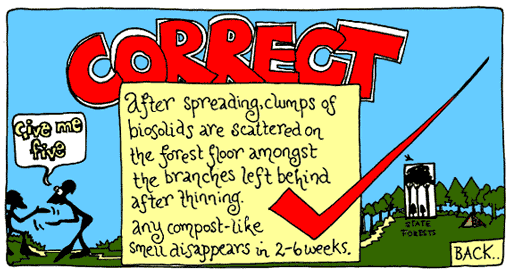
I think that Biosolids have both positive and negative effects on the earth and people. I also don’t believe that biosolids as know as human waste is a good fertilizer because of all of the artificially selected foods we eat. Biosolids is a sort of pollution, which will affect the air around us and the oxygen we take in. They should conduct more experiments and research more before they go ahead and use human waste as fertilizers in farms and other lands. While biosolids certainly provide valuable nutrients to agricultures, advocates of biosolids have not adequately addressed concerns raised but those oppose to the practise. Biosolids are believed to be linked with declining sperm counts and reproductive failure. Therefore we need more research on this topic before biosolids can be used as fertilizers.

http://youtube.ca/watch?v=QpiZReZG4_A
WORKCITED
http://www.ncbi.nlm.nih.gov/pubmed/18023841
http://www.antijen.org/transadvocate/id22.html
http://southeastfarmpress.com/grains/fertilizer-alternatives-0604/
http://thechronicleherald.ca/NovaScotia/1176241.html
http://www.schwingbioset.com/news/bid/34089/Natural-Fertilizer-from-Biosolids-reuse-to-the-Nth-degree-Part-I
http://www.cwwa.ca/faqbiosolids_e.asp
http://ehpnet1.niehs.nih.gov/qa/105-1focus/focusbeauty.html


very informational. nice work Aarany
ReplyDeletehey,
ReplyDeleteSo it's a great blog, tons of information. But I can't help but mention that you didn't side in on the topic. I personally believe that biosolids shouldn't be used for agriculteral purposes. Our waste should not help provide food for us, it's absolutely disgusting.
Hey nice blog. I learned a lot of information from your bioblog. I wasn't sure which you were siding with because you never really said if you thought it was good or bad. I can see why you would be undecided because there is still a lot of research necessary before we fully understand how biosolids affect the environment and ecosystems. Hopefully in a few years we'll be able to more fully understand its impact.
ReplyDeleteYo Aarany!
ReplyDeleteI'm here to post a comment on your last bioblog and like you I cannot decide on what side to take. I totally agree with the fact that biosolids are in need of more research so that scientists or farmers can be 100 percent sure that what they are doing is totally the right thing and it contributes in a good way to our environment. Also the pictures that you have added on are a helpful way for biosolids to be more easily understood. It has told us that it can smell very bad and it's not something that we all can stand but hey if it helps fertilize our plants that why not? You have done a great job on your last strand of biology and you make it easier for me to understand what biosolids are other than google. See ya tomorrow in chem!
thanx guys! i had trouble picking a side. sorry.
ReplyDeleteHey Aarany! Don't apologize I completely agree with your indifferent situation. It is better to do more research and be confident in your opinion than to just follow what someone else is telling you since they too do not know the correct answer.
ReplyDeletePersonally, if a few more tests are done to support the use of biosolids for farming I think I'd be likely to support that. I am interested in any cheap form of recycling and helping the environment. However, if this solution was actually harming the environment I would not support it at all. I'm hoping that is not the case this time though so that we can put our resources to work.
Hey Aarany,
ReplyDeleteI like the fact that you did not choose but instead researched and further showed both side of the stories. It gave me a taste of he indeffernces between both pros and cons. I think that it should be further tested as well and in a way to get rid of the toxins and to benefit the environemtn because i believe it has many poctive atributes such as reducing the amount of landfill we have. I liked you pictures they gave us a visual idea of what you were describing.
Overall great blog!!
Hey Aarany
ReplyDeleteGreat blog. It was highly informative and I like it alot. You made some good points, espicially that there is not alot of data on biosolids and any of the possible health risks. However, I still feel that using them as a fertilizer is a good idea...kind of like the innoscent unti proven guilty approach :D As well, in the state of florida, 100% of their biosolids are used as fertilizers on land [orangecountyfl.net], and the florida oranges bought at the stores are fertilized by, yep, biosloids. So many people eat these crops and STILL Hardcore proof that biosolids are harmfull very harmful, I think that this prooves enough that it is safe. I agree that this is a tough topic to pick a side ( im kinda goin with a yes to biosolids :D ) But the effects of biosolids on the reproductive system that you mentioned was interesting too. You did a great job on representing both sides of the argument + you had some cute little cartoons + your highly informative points + awsome blog!
Anjali
HI AARANY,
ReplyDeleteFirst and foremost, great blog. It was really well-done and sounded very well researched. I noticed that you were really undecided about what side you would take. I completely respect that. Personally, I think that although there are benefits and disadvantages, the benefits outweigh the disadvantages. I think that the benefits for the land and society is more worth it than worrying over risks that might no even be there. However, I do understand where you are coming from. There should be more research done and it should be proven that they are 100% safe. Good job, i enjoyed reading your blog :)
Hey Arany !!
ReplyDeleteI thought your blog was great, very informative and well written.I see you didnt't choose a side... but that's okay :). I personally think that there are some advantages and disadvantages to using sewage biosolids but I think it's a great alternative. Alot of our foods today are grown in biosolid fertilizer and it tastes the same to me if not better (cause it's not filled with gross chemicals)so I think the use of biosolids is great and it helps the environment and society as well.
Great job :)